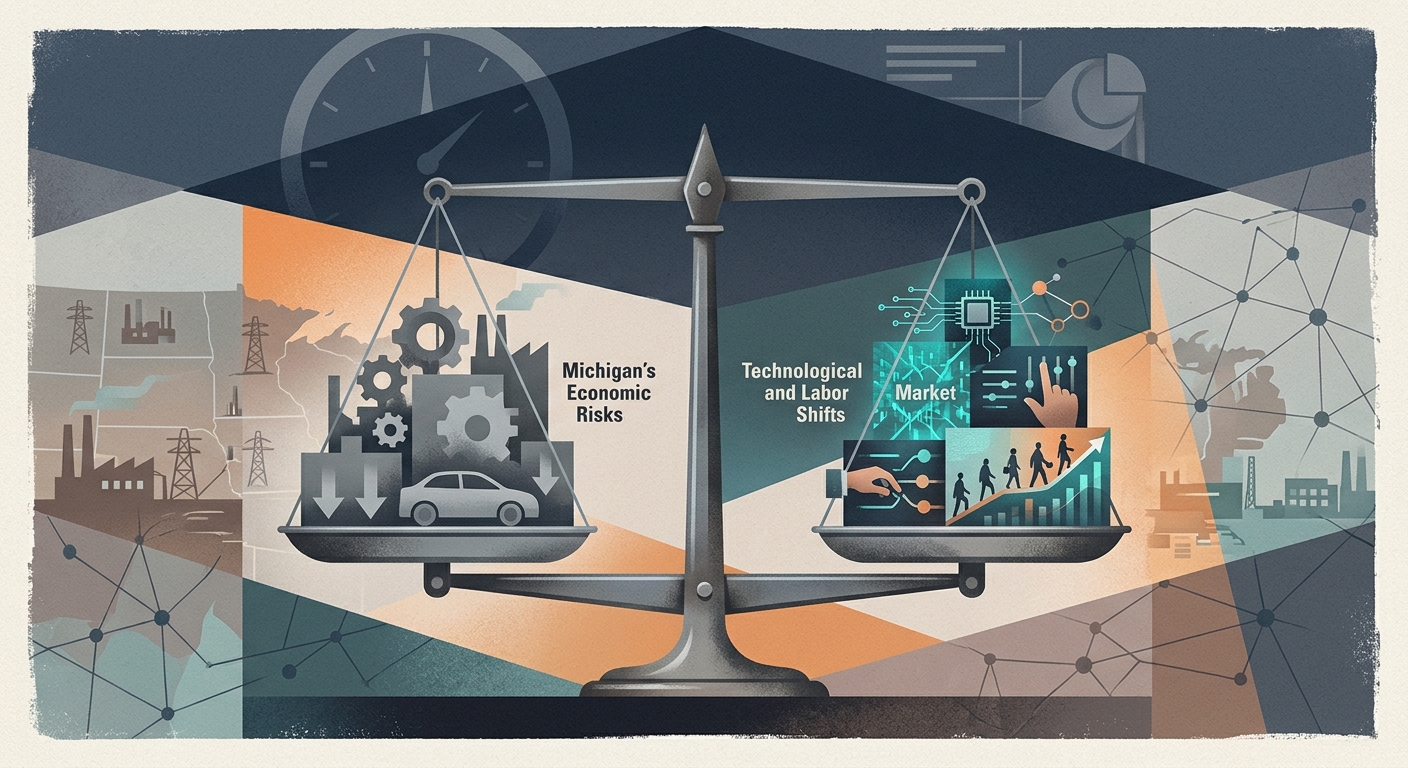
AI-generated illustration; not a photograph of the reported event.
- calendar_today November 3, 2026
As Michigan navigates a period marked by rapid technological innovation and shifting labor dynamics, recent assessments from Federal Reserve officials provide key insights into the economic challenges and opportunities facing the state. Their analyses highlight both resilience and risk in the regional economy, particularly as artificial intelligence (AI) and industrial transformation intersect with Michigan’s labor market and core sectors such as the automotive industry.
Federal Reserve Governor Michael Barr emphasized Detroit’s continued importance while acknowledging its elevated unemployment rate—around 11 percent, significantly higher than both the state and national averages—and underscored the city’s rebirth led by entrepreneurship and strong business formation. The automotive sector, central to Michigan’s identity, remains a major employment engine, with auto manufacturing jobs and ongoing investments in battery and electric vehicle technology facilitating high-tech job creation. However, Barr noted that new business formation in Detroit outpaces Michigan as a whole, suggesting localized entrepreneurial dynamism (Federal Reserve, Barr Speech).
Technological change, especially the proliferation of AI, is a central concern for policymakers. Massive investment in AI infrastructure has boosted demand for high-tech goods, with spillover effects seen in labor and product markets. Barr highlighted both the potential for AI to improve productivity and living standards and the risk of short-term disruptions, especially for entry-level workers in sectors heavily exposed to automation. While substantial displacement due to AI remains limited so far, Barr pointed to scenarios where rapid adoption could outpace the labor market’s ability to adjust, potentially resulting in significant, albeit temporary, dislocation for less-experienced workers. The policy challenge, therefore, involves supporting job creation and worker retraining to help Michigan’s workforce adapt to these shifts (Federal Reserve, Barr Speech).
From a national and regional perspective, Vice Chair Philip Jefferson’s outlook underlines ongoing uncertainty in the economic landscape. Although business investment, particularly in high-tech and AI-related capital, is supporting growth, headwinds from elevated energy prices and geopolitical developments such as the conflict in the Middle East persist. These factors add notable uncertainty to both national and Michigan-specific forecasts, especially given Detroit’s historic sensitivity to global trade flows and commodity prices (Federal Reserve, Jefferson Speech).
Looking at labor, the Detroit area’s unemployment rate remains above the U.S. average but has seen the gap narrow in recent years—a sign of both regional resilience and economic diversification. Health care and social services jobs have surged, while manufacturing employment has declined over the longer term. Still, total employment in the metro area has yet to return to its early-2000s peak. Jefferson noted that job growth has become more concentrated in a few industries and that recent labor market stabilization—marked by steady unemployment rates and increased labor force participation among prime-age workers—should be approached with caution, as ongoing uncertainties could still destabilize recent gains (Federal Reserve, Jefferson Speech).
Overall, Federal Reserve officials remain cautiously optimistic about Michigan’s economic prospects in the face of technological transformation. They stress the importance of monitoring productivity gains, actively managing potential dislocations from AI, and supporting a diversified labor market. Continued adaptation and investment in workers’ skills, coupled with vigilance in monetary policy, are seen as necessary steps to ensure Michigan’s economy remains resilient amidst these challenges.