- calendar_today August 13, 2025
Michigan’s commercial real estate (CRE) market entered 2025 with cautious optimism. But midway through the year, signs point to a mixed and sector-dependent recovery. While industrial and multifamily assets in key metros like Grand Rapids and Ann Arbor are proving relatively resilient, the office and retail sectors—particularly in Detroit—are grappling with deep structural and financial challenges.
The state’s evolving economy, demographic shifts, high interest rates, and changing land use policies are shaping CRE dynamics from southeast Michigan to the Upper Peninsula. Below are seven key insights into the forces defining Michigan’s real estate outlook in 2025.
1. Detroit’s Office Market Remains in Flux
Office vacancies in Detroit remain elevated, with Q2 2025 data from JLL showing a 21.7% vacancy rate in the CBD. While Class A spaces in modernized buildings such as One Campus Martius continue to attract major tenants, legacy office stock is increasingly underutilized.
Remote work trends persist, especially in finance, law, and professional services. Many firms are downsizing or shifting to hybrid layouts, leaving older office towers in Midtown and downtown struggling to remain viable. Leasing activity has slowed, and landlords are offering rent abatements and tenant improvement allowances to stay competitive.
Ann Arbor’s office market has fared better, buoyed by stable demand from the University of Michigan and biotech tenants, though activity has cooled relative to pre-pandemic years.
2. Retail’s Uneven Rebound Varies by Location
Retail real estate across Michigan tells two very different stories. Suburban shopping centers anchored by grocery stores and service-based tenants are performing relatively well in areas like Novi, Troy, and Holland. However, urban retail corridors and traditional malls in Flint, Lansing, and Detroit are facing persistent vacancies.
The Somerset Collection in Troy remains a bright spot, reporting higher-than-average foot traffic and luxury brand expansions. Meanwhile, large-format malls like the Lakeside Mall in Sterling Heights have faced redevelopment pressure, with plans in motion to convert such sites into mixed-use town centers or residential complexes.
E-commerce and changing shopping behaviors are prompting many landlords to seek non-traditional tenants, including medical offices, logistics hubs, and community services.
3. Industrial Space Remains a Bright Spot, But Cooling Is Evident
Michigan’s industrial market, particularly around Detroit’s automotive corridor, remains relatively strong. The transition toward electric vehicles (EVs) has spurred demand for manufacturing and logistics spaces near Dearborn, Livonia, and Romulus.
Ford’s BlueOval Battery Park and GM’s Ultium joint venture in Lansing continue to draw supplier interest, but speculative warehouse development is slowing. According to CBRE, industrial vacancy in southeast Michigan edged up to 5.9% in Q2 2025 from 4.2% a year earlier as new inventory outpaced leasing.
Regions like Grand Rapids and Kalamazoo, once hotbeds for industrial expansion, are seeing slower absorption rates. Demand is shifting toward flexible-use and last-mile distribution hubs, especially in locations near I-96, I-75, and Detroit Metropolitan Airport.
4. Multifamily Remains Resilient but Faces Cost Challenges
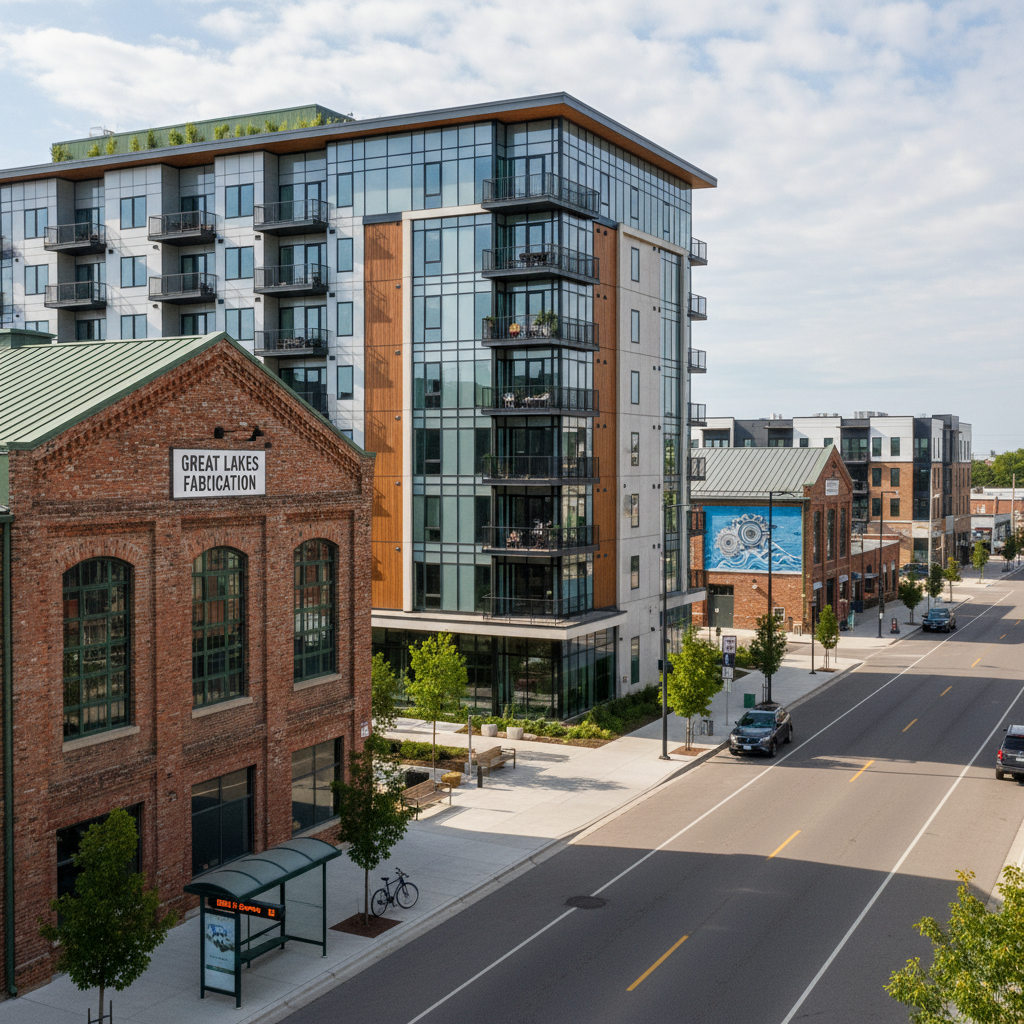
Multifamily housing is one of Michigan’s most stable real estate segments in 2025. Demand for rentals remains strong in Ann Arbor, Grand Rapids, and the Detroit suburbs, driven by millennial renters, students, and downsizing boomers.
However, rising construction and financing costs are squeezing developers. Statewide, multifamily permits declined 15% year-over-year in the first half of 2025, per U.S. Census Bureau data.
Rent growth has slowed, particularly in urban areas. Yardi Matrix data shows average Michigan rents increased by just 1.8% annually through June—down from 4.6% in 2023. Class B and C properties in working-class neighborhoods continue to see the highest occupancy rates.
Build-to-rent communities and townhome developments are gaining traction in outer suburbs like Brighton, Portage, and Traverse City.
5. Transaction Activity Is Sluggish Across Most Asset Classes
CRE investment activity in Michigan has declined significantly in 2025. MSCI reports a 29% year-over-year drop in transaction volume for the first half of the year. Cap rates for office and retail assets have widened amid uncertain valuations and higher borrowing costs.
Industrial properties remain the most actively traded asset class, particularly in supply-constrained markets like Ann Arbor and Romulus. However, many institutional investors are sitting on the sidelines or focusing on distressed opportunities, especially in Detroit’s urban core.
Several downtown Detroit office towers are rumored to be in negotiations for recapitalization or repositioning, suggesting that distress-driven sales may rise in the second half of the year.
6. Public Policy, Zoning, and Incentives Remain a Key Variable
State and local governments in Michigan are attempting to stimulate CRE recovery through targeted policy reforms. In Detroit, the city is offering tax abatements and expedited permitting for office-to-residential conversions in downtown buildings. However, developers cite hurdles related to zoning codes, parking requirements, and conversion costs.
In Ann Arbor, affordable housing initiatives and density bonuses are encouraging new multifamily construction—but neighborhood opposition has stalled several projects. Meanwhile, Grand Rapids continues to use Opportunity Zones and brownfield incentives to attract developers to underutilized industrial sites along the Grand River.
Statewide, there is increasing attention on workforce housing and adaptive reuse programs. But bureaucratic delays and inconsistent municipal approaches remain obstacles.
7. ESG and Innovation Remain Long-Term Differentiators
Despite short-term headwinds, ESG strategies are gaining momentum in Michigan. Developers and investors are incorporating energy-efficient systems, solar installations, and walkable design into new projects—especially in Ann Arbor and Grand Rapids, which have municipal carbon goals in place.
Additionally, innovation in sectors like biotech, EV manufacturing, and clean energy is influencing the real estate landscape. In Ypsilanti, for instance, Eastern Michigan University is partnering with private firms to convert land into a tech campus, while Detroit’s Corktown is evolving into a mobility and smart infrastructure hub.
Long term, such projects could transform commercial property demand patterns across the state.
Outlook for the Remainder of 2025
Looking ahead, several forces will shape the second half of Michigan’s CRE story:
- The Federal Reserve’s pause on rate hikes may stabilize financing conditions, opening opportunities for acquisitions and refinancing.
- Office-to-residential conversions in downtown Detroit could unlock value if barriers are overcome.
- Continued industrial demand from EV and tech manufacturing may support leasing in strategic corridors.
However, Michigan’s market will remain bifurcated. Office and traditional retail assets in older urban cores will likely continue to struggle, while industrial and multifamily properties in high-growth suburbs and university-adjacent markets remain more resilient.
Bottom Line
Michigan’s commercial real estate recovery in 2025 is a tale of divergence. The state’s evolving economy—anchored by innovation, education, and industry—offers opportunities for long-term investors. Yet, near-term pressures from interest rates, labor shortages, and structural CRE shifts mean that asset selection, location, and adaptive strategies will be critical for navigating a still-uncertain path forward.