- calendar_today August 27, 2025
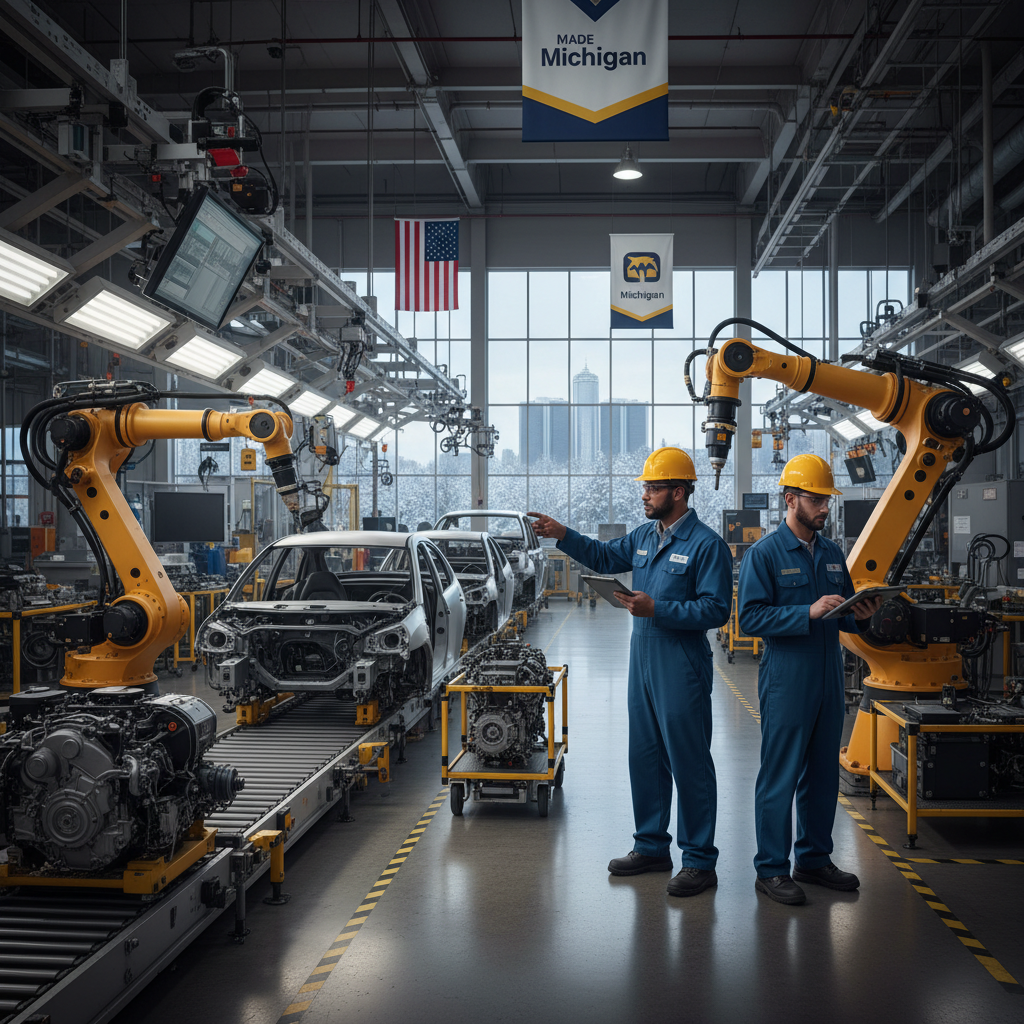
Artificial intelligence (AI) is rapidly emerging as a ubiquitous force of modern life, from voice recognizers and smart vehicles to chatbots and autonomous factory floors. Beyond the convenience, however, AI also promises to upend how work is done. In Michigan, a state famous for its manufacturing base, automotive industry, and health care providers, that transformation is already begun.
By 2030, up to 50% of jobs worldwide will be impacted by AI and automation, according to experts such as the World Economic Forum. Such an estimate has raised alarm and interest among Michigan’s labor force. What will happen to jobs? Will some jobs cease to exist? And most importantly, how will workers adjust?
Michigan’s Workforce and the Rise of AI
Michigan has been the heart of American manufacturing for a long time. From Detroit’s automotive factories to Grand Rapids’ furniture factories, many of the state’s goods are based on skilled workers. But automation in these factories has been spreading for decades, and AI is the next wave.
Smart systems and robots are now doing jobs that once took teams of human workers. For instance:
- Automakers are leveraging AI to track assembly lines and catch product defects in real time.
- Logistics companies are looking to predictive algorithms to streamline delivery routes and save money.
- Healthcare providers are applying AI to diagnostics, billing, and patient scheduling.
Michigan workers are experiencing the changes. Some see them as opportunities for innovation. Others are more apprehensive, worried about being laid off or seeing their traditional jobs eliminated.
A Tale of Two Perspectives
Responses to the growth of AI in Michigan have been mixed based on the sector and locality.
In Detroit, formerly the Motor City, numerous employees are already accustomed to being automated. For others, the newest AI improvements are merely the next stage in a decades-long progression.
“I’ve been on the line for over 20 years,” says Marcus Johnson, an assembly worker at an electric vehicle plant. “Robots took over some of our jobs, but now it’s about learning how to work with them, not just being replaced by them.”
By contrast, northern Michigan’s rural workers, in whom high-tech employment is less prevalent, perceive AI as a threat to their livelihoods rather than as an instrument. Local economies that are based upon agriculture, retail, and hospitality will be challenged to accommodate advanced technology without substantial investment in infrastructure and retraining.
The Role of Education and Retraining
Michigan has been ahead of the game in reacting to the impact of AI. The state government, in cooperation with local employers and colleges, is introducing new training programs that will prepare employees for the evolving nature of the workplace.
Michigan State University, the University of Michigan, and a system of community colleges are providing certificate and degree programs in:
- Artificial Intelligence
- Robotics Engineering
- Data Analysis
- Cybersecurity
- Advanced Manufacturing
Community colleges such as Oakland Community College and Lansing Community College are adapting short-term programs for mid-career professionals who require quick, low-cost reskilling.
Perhaps the biggest challenge is providing access to these resources in urban and rural areas. Closing the digital divide is important so that all workers, no matter their ZIP code, have a fair shot at adjusting.
Policy and Industry Involvement
Governor Gretchen Whitmer and state legislators have recognized the increasingly growing impact of AI on Michigan’s economy. The Michigan Workforce Development Agency was charged with creating solutions to assist residents in adapting.
Among the efforts are:
- Futures for Frontliners: A free community college program for frontline workers, many of whom are in positions vulnerable to being automated.
- Michigan Reconnect: Provides tuition support to adults seeking career change or the ability to gain higher-level skills.
- Employer tax credits: For firms that offer AI-based training to staff instead of firing them.
Private firms are also making investments in talent development. Car manufacturers such as Ford and GM are collaborating closely with schools to equip students for the mobility future, while health networks are educating employees on emerging AI-driven diagnostic tools.
Small Business and the AI Curve
Michigan’s small businesses have one special challenge: how to stay ahead of AI without the fat wallets of a big company.
But many are adapting by leveraging AI tools. Local companies are implementing:
- AI chatbots for customer support
- Intelligent inventory systems that forecast sales patterns
- Social media platforms are fueled by machine learning to maximize marketing
These tools not only increase efficiency but also help small enterprises compete in an increasingly digital marketplace.
The Emotional Side of AI’s Expansion
Beyond numbers and technology, there’s a human element that cannot be ignored. Many workers worry about their long-term job security. Parents wonder what skills their children will need in 10 years. And educators are under pressure to prepare students for jobs that may not yet exist.
That is why mental well-being and career counseling are being emphasized. Counseling centers, employment counselors, and community groups throughout the state are giving aid to those worried about the future.
“I thought I was too old to learn something new,” says Sharon, a 52-year-old retired store manager from Flint. “But then I took an online course in data entry and now I work part-time at home. It’s not what I had in mind—but it works.”
A Future Still Full of Possibility
Michigan stands at a pivot point. The state’s proud industrial heritage now converges with a data-driven, automated, digital future. Disruption will be part of the path forward, but so too is potential.
The solution lies in preparation, not panic. With forward-thinking policy, affordable education, and support for families and communities, Michigan’s workers will be able to ride the transition with strength.
AI might be transforming the way we work, but it won’t change the essence of Michigan’s workforce: hard work, flexibility, and pride in constructing tomorrow.