- calendar_today August 10, 2025
Obscure LA museum battles fire, faces costly recovery
Few places in Los Angeles are quite as strange as the Museum of Jurassic Technology, a curiosity cabinet with an ardent following that endured a serious fire earlier this month. Although damage was contained to the gift shop and smoke damage throughout the facility, the MJT will be closed while cleanup and repairs are completed. The estimated cost in lost revenue during closure could reach $75,000, and the institution hopes to reopen next month.
Located in Culver City, the Museum of Jurassic Technology has maintained a long-standing cult following in LA’s arts community, having attracted visitors for more than 30 years with exhibits that run the gamut from the mystifying to the misleading. The museum, which describes its mission as being “dedicated to the advancement of knowledge and the public appreciation of the Lower Jurassic,” makes use of a grab bag of historical curios and idiosyncratic taxonomies more than it does the actual Jurassic period. Indeed, the MJT was created as a sort of tribute to Renaissance-era wunderkammers (curiosity cabinets), an early Western cultural tradition that foreshadowed modern museums.
Diverse in style and method, the museum has a complex track record. While some of its offerings are bona fide artifacts from various periods in history, some of its stories are fictional, or at least more ambiguous than the museum’s displays would suggest. Take the first item on the permanent collection, which reads: “Athanasius Kircher 1602–1680. Jesuit polymath who became a legend in his own time.” Kircher was, in fact, a real German Jesuit priest who lived in the 1600s and became an authority on various subjects from Egyptology to natural science. Adjacent is the work of Hagop Sandaldjian, an Armenian sculptor who made extremely tiny sculptures using a single human hair as his medium and the eye of a needle as his mold.
Elsewhere in the museum, you’ll find decomposing dice from the personal collection of magician Ricky Jay, a visual essay on Los Angeles-area trailer parks called “The Garden of Eden on Wheels,” stereographic radiographs of flowers, microscopic mosaics made from butterfly wing scales, and even an archive of letters from amateur astronomers who wrote to the Mount Wilson Observatory between 1915 and 1935.
Since 2005, the museum has also housed a Russian tea room inspired by the study of Nicholas II of Russia in the Winter Palace of St. Petersburg.
Fire and Aftermath
A lengthy first-person account of the fire published by writer Lawrence Weschler (whose 1996 book Mr. Wilson’s Cabinet of Wonder looks in depth at the curiosities housed by the MJT) described the early moments of the incident. The blaze was spotted by David Wilson, one of the museum’s co-founders and director emeritus. Wilson, who lives in a residence behind the MJT, was able to get to the museum in time to witness the fire as it began its ascent on the corner of the building facing the street.
Wilson described the fire to Weschler as “a ferocious column of flame.” By the time he was able to get to the scene, however, the two fire extinguishers he brought with him weren’t enough to put out the blaze. Fortunately, Wilson’s daughter and son-in-law arrived a few moments later with a larger extinguisher and were able to douse the fire just before the fire department arrived. Fire personnel later told Wilson that they had arrived on the scene just one minute too late, and the building would likely have been destroyed if not for his daughter’s arrival.
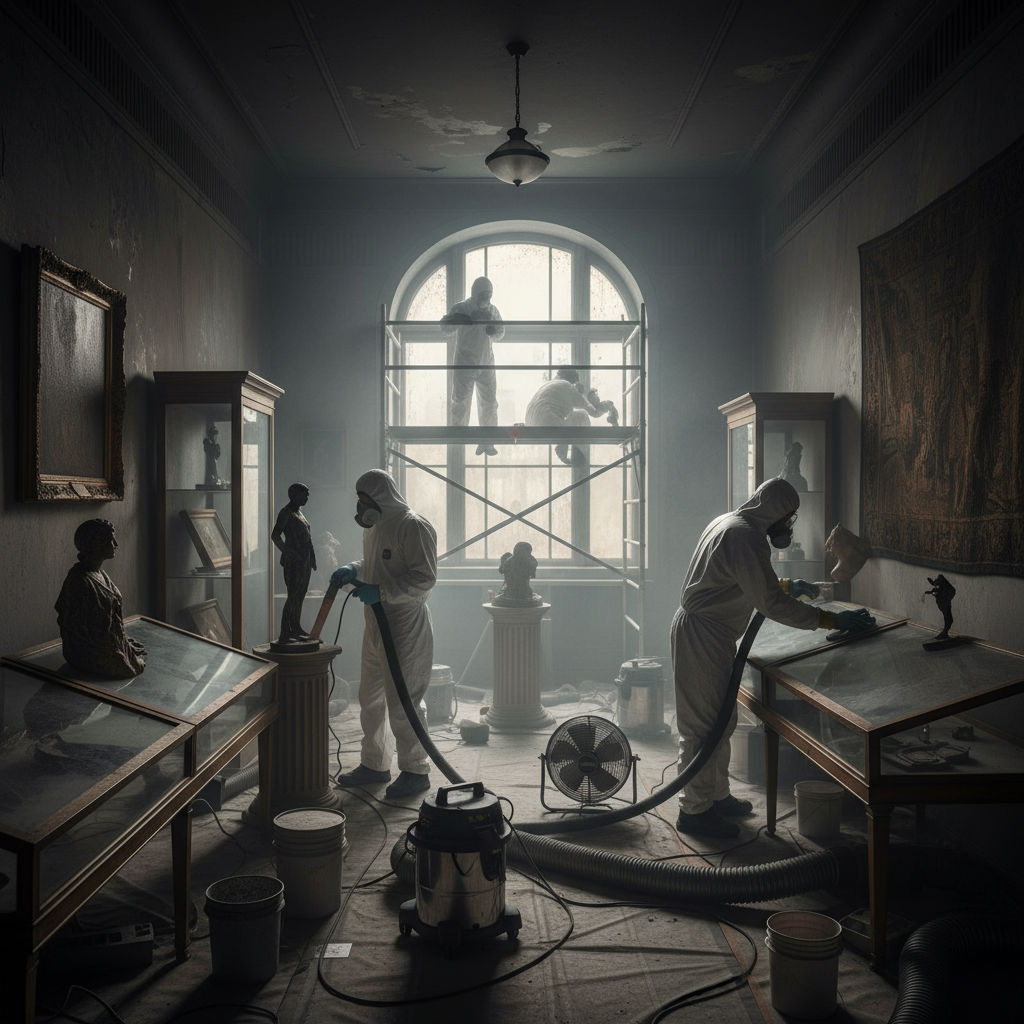
The gift shop, while structurally damaged, was only one part of the problem. Smoke from the fire made its way throughout the museum. Wilson described the smoke damage as being akin to “having a thin creamy brown liquid… evenly poured over all the surfaces—the walls, the vitrines, the ceiling, the carpets, and eyepieces, everything.” Smoke infiltration is notoriously difficult, even for new constructions, and a facility with MJT’s focus on presentation and details will have a difficult road ahead. Since the fire, the museum’s staff and volunteers have been working full-time to restore the affected areas, a process which has been described as slow and painstaking.
Supporters are instead asked to make donations to the museum’s general fund in order to mitigate loss and clean up. Weschler has described the museum as “one of the most truly sublime institutions in the country,” emphasizing that it is a rare and singular institution, difficult to categorize as either science or art, or narrative.
The museum has not set a firm date to reopen, but the MJT will likely be back to its quixotic best sooner rather than later. As the museum’s Twitter page describes the incident: “fire is but one more character in our Shakespearean drama of satire and scholarship and surrealism.”