- calendar_today August 16, 2025
.
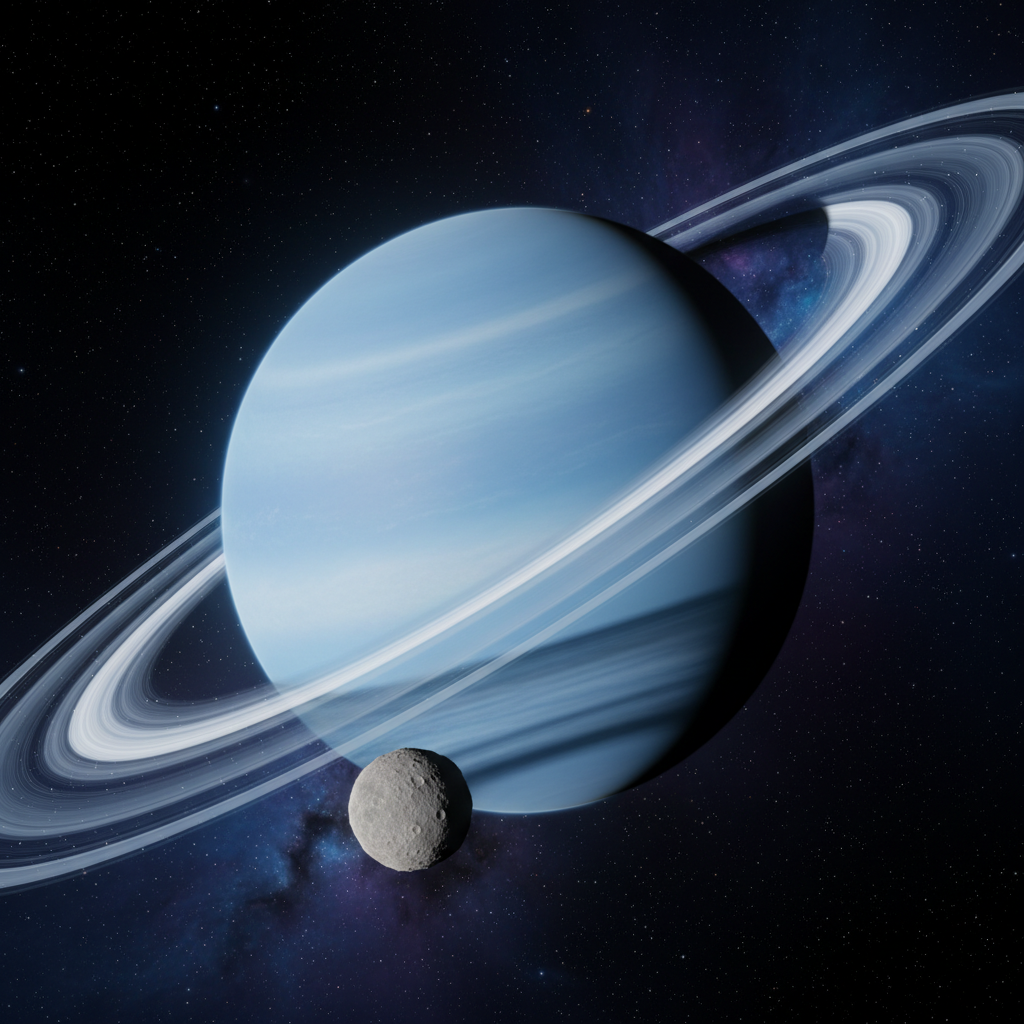
Astronomers have discovered a new moon orbiting the ice giant planet Uranus using the James Webb Space Telescope. The previously unseen moon is one of the smallest natural satellites of Uranus, helping to take the total number of Uranus’ known moons to 29, but scientists suspect additional ones still await discovery.
Webb exposed the faint object on February 2 using a set of long-exposure, 40-minute images from its Near-Infrared Camera. The moon is just 6 miles (10 kilometers) in diameter. It’s one of the smallest moons discovered around Uranus to date. Its tiny size and the bright glow of Uranus’ rings likely hid it from previous missions and telescopes. Even NASA’s Voyager 2 spacecraft, which flew past Uranus nearly 40 years ago, didn’t spot it.
“This is a small moon but an exciting discovery,” said Maryame El Moutamid, a lead scientist in the Southwest Research Institute’s Solar System Science and Exploration Division in Boulder, Colorado. El Moutamid is the principal investigator of a Webb program focused on studying Uranus’ rings and inner moons. “It is a great reminder of how Webb is taking our knowledge of these solar system objects far beyond that provided by previous missions,” she added.
The new object, currently known as S/2025 U1, is about 35,000 miles (56,000 kilometers) from the center of Uranus. It orbits nearly circularly in the planet’s equatorial plane, between two other known moons, Ophelia, just beyond Uranus’ main ring system, and Bianca. Its orbit is not far from Uranus’ main rings, so it may have formed near its current location.
The moon’s dark, tiny, and fast-moving characteristics made it a challenge to distinguish from the glare of Uranus and its rings. Webb’s sensitivity to faint infrared light, however, allowed astronomers to see it. The telescope recently offered a rare glimpse into Uranus’ rings, weather, and atmosphere. The latest discovery builds on that record.
Deciphering Uranus’ Mysterious System
The discovery is not only important because it extends the known Uranian moon family by one more member. The study also ponders the origin of Uranus’ ring system, which could also include S/2025 U1. Scientists believe the tiny moon and some of Uranus’ rings share the same origin, that they are fragments of the same ancient breakup event.
“The discovery raises questions about how many more small moons remain hidden around Uranus and how they interact with the planet’s rings,” El Moutamid said. Currently, Uranus has five major moons—Miranda, Ariel, Umbriel, Titania, and Oberon—plus an ensemble of smaller satellites that orbit close to the planet, of which the new body is the 14th. No other planet in the solar system has as many small inner moons so close to one another, and this is a mystery to astronomers. The satellites are so close that their orbits should overlap, yet they are stable. Astronomers think the moons may shepherd the planet’s narrow rings and prevent them from spreading out.
Scott Sheppard, an astronomer with the Carnegie Institution for Science who was not involved in the new study, but who also co-discovered a new moon around Uranus in 2024, told Newsweek the discovery is “very exciting.” He said the object is “quite interesting because of its close association with Uranus’ inner ring system.” He also praised Webb for its ability to reveal the object. “It would not be possible to detect the moon from the ground or with the Hubble Space Telescope.”
The SETI Institute’s Matthew Tiscareno, a co-principal investigator in the Webb Uranus project, said the finding blurs the line between Uranus’ moons and rings. “Their complex inter-relationships hint at a chaotic history,” he said in a statement. He also explained that the newfound moon is even smaller and fainter than the smallest known Uranian inner moons, suggesting additional satellites await discovery.