- calendar_today August 15, 2025
In Memory of Michael Madsen: His Other Killer Role in Species
Last month, actor Michael Madsen passed away, leaving behind a filmography of gritty, memorable performances in films like Reservoir Dogs, Kill Bill, and Donnie Brasco. It was a long and storied career in Hollywood, and while there have been many tributes to his larger-than-life persona and memorable character choices, few have remembered one of Madsen’s more esoteric roles: as a black ops mercenary in 1995’s Species.
A Cult Sci-Fi Mystery That Pushed the (Monster) Envelope
Species was a remarkable sci-fi movie, simultaneously clunky and timely for an age flush with monster movies, creature features, and ’90s alien paranoia. With the success of Terminator 2 and Jurassic Park the year before, audiences were hungry for stories about potentially unstoppable, invasive life-forms—and with the ice-breaking in Antarctica still a decade away, extraterrestrial life seemed like a rarer and more precious gift than ever before.
The concept was simple: two radio signals arrive from outer space, one containing a blueprint for a new fuel source, and the other containing a set of highly detailed, step-by-step instructions on how to splice human and alien DNA together. The government takes the bait, and under the guidance of Dr. Xavier Fitch (Ben Kingsley), a hybrid human/alien is born in a top-secret government lab: a girl they call Sil, played in her younger years by Michelle Williams. The human side of her DNA comes from Fitch’s cells.
The experiment was meant to produce a subservient, easily controlled life form. Instead, the government finds itself in possession of a monster.
Sil ages at an alarming rate, reaching the body of a 12-year-old in a matter of three months. But she’s starting to show signs of trouble. Nightmares, acting out, and even potential references to the serum she was injected with as an infant. When Fitch attempts to kill Sil by releasing cyanide gas into her holding cell, the alien girl uses the confusion to slip away, and the story begins.
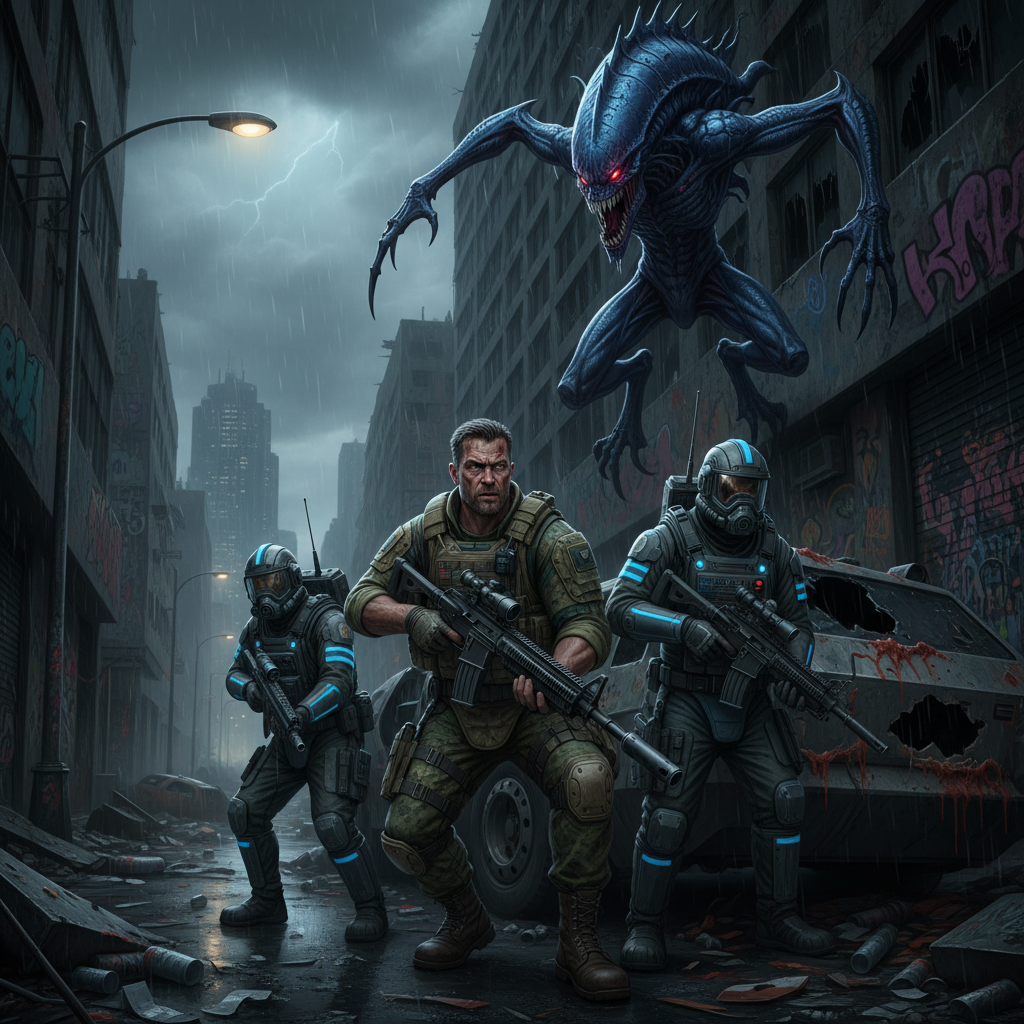
A crew of assorted eggheads, with Madsen’s Preston Lennox leading the charge, is assembled to hunt Sil down and take her out. Madsen plays a stoic, trigger-happy mercenary sent to retrieve Sil and the cell in which she’s been held. He’s joined by Dr. Laura Baker (Marg Helgenberger), a molecular biologist; Dr. Stephen Arden (Alfred Molina), an anthropologist; and a brooding, mysterious empath named Dan Smithson, played by Forest Whitaker. Smithson is a key piece of the puzzle because he has the unique ability to sense what Sil is thinking and feeling.
Their journey takes them across the country and finally to Los Angeles, where a now-full-grown Sil has made a mad dash to seek out her mate and reproduce. Played by Natasha Henstridge, Sil is a thing of both incredible wonder and unspeakable horror. Her DNA was designed to adapt quickly and constantly to any stimuli. She’s smart, resourceful, and ruled entirely by instinct. One by one, the team from the government lab hunts her down and slowly puts together what she is and what she will become: a full-grown, pregnant alien who can reproduce at an alarming rate. One by one, the cast is murdered in quick succession, starting with a hapless train tramp (she just grabs his head and pulls) and moving on to a nightclub victim before the inevitable choice of a fated lover. The team must race to put an end to the nightmare before her new alien brood can continue without her.
The Species of Sil: Perfect Monster for the 1990s
One of the most striking aspects of Species was its titular alien. Legendary surrealist H.R. Giger, best known for his designs for the xenomorph alien in Alien, was brought on to design Sil as well as a new, third species of extraterrestrial to challenge the crew at the end. Giger’s goal was to make Sil an alien built not only to kill, but to seduce.
He told Omni magazine in 1995, “Sil was supposed to be an aesthetic warrior, also sensual and deadly.” The effect was striking: Sil’s adult design featured translucent skin that Giger described as “a glass body but with carbon inside it.”
Giger had originally been asked to provide multiple stages of alien evolution to make the serum more plausible and show how it mutated Sil from infancy to adulthood. Instead, the team had to settle for a transformation cocoon for Sil to hide in and an incredibly lifelike, blue-skinned alien mother as the big boss at the end.
While Species was a runaway box office hit, Giger was left deeply disappointed with how the finished film turned out. He felt that Species had drawn too heavily on his previous work in Alien, especially his design of the creature’s iconic “punching tongue” and even the closing “birth scene,” which he said was more than similar enough to the chestburster birth scene in Alien to warrant legal action against the producers.
He said in 1995, “Species was very similar to Alien in several ways, unfortunately. The alien in Species is a recycled one. I have to say I was quite upset about it because Species was a great idea.” He was able to at least change the ending by threatening to withhold his designs for Sil until the filmmakers agreed to have her killed with a bullet to the head, rather than the flame-throwers that would have mimicked both Alien 3 and Terminator 2 too closely for his liking.
Species, which even now remains a hard title to track down, was a massive success. For all its mediocre performances and uneven script, it remains a mesmerizing creature feature, with memorable special effects and visual gags aplenty. The script, by former film critic Joseph Loeb, was especially inspired: Loeb’s original ideas for the script came from an article he found in Arthur C. Clarke’s 1995 Asimov’s magazine column. Clarke wrote an article on the incredibly minute probability of FTL (Faster Than Light) travel in the cosmos, and he went on to suggest that perhaps extraterrestrial life would never visit Earth at all if faster-than-light travel was such a statistical improbability.
Loeb’s breakthrough: what if, he wondered, aliens were to make contact, but with the help of a blueprint? An organic, living species created out of Earth’s DNA? The result was a meditation on genetic engineering and bioethics as much as a warning about alien invasion—and a monster to introduce a new generation of audiences to Giger’s magnificent, unfathomable design.
Species will never be an Alien, or even a Terminator. It’s never going to enjoy the same fame or notoriety or classic status as those genre-defining sci-fi cornerstones. But as a cult curio of 90s-style body horror and suspense, Species remains one of the must-see movies of the era. In between Natasha Henstridge’s ice-blue eyes, Madsen’s sunken-eyed glare, and a hell of a villain design from Giger, Species is a”’ ”’ ’90s-style piece of sci-fi that still holds up today in ways the reviews of the time never gave it credit for.
In his early 20s, Bryan (@bdyouknow) was a millennial slacker who hated movies but loved them all the same. As an adult, Bryan’s fascination with horror and comedy movies has only deepened, and he never met a cult film or TV show he didn’t like. Bryan now lives in New York with his rescue cat and works as a web developer by day and a reviewer by night.