- calendar_today August 14, 2025
.
EV adoption in the US is under new doubt following recent declines in sales and lagging infrastructure. After a year and a half of steady month-over-month growth, EV sales have started to shrink. Automakers including Genesis and Volvo have seen buyers turn away from electric cars, with both automakers pausing sales of their EVs.
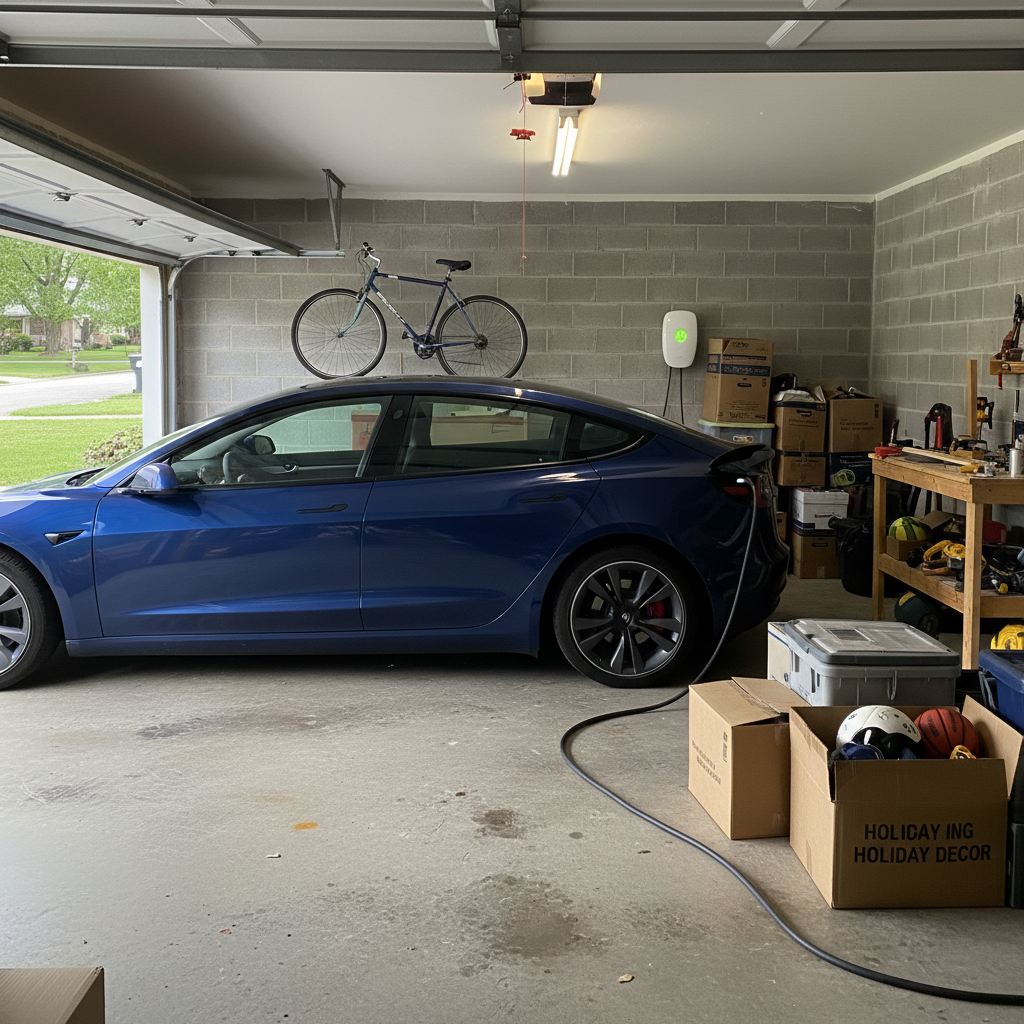
Uncertainty is compounded by the political climate. The Biden administration has reduced subsidies and reversed car pollution rules, eliminating many federal incentives for buyers. But analysts say that the biggest hurdle for EV adoption may be less political and more…parked in garages.
Consumer surveys have long cited charging anxiety as the most significant adoption barrier, but a new Telemetry market research report by VP Sam Abuelsamid drills into the reasons why.
Highlighting an issue often buried in headlines focused on DC fast charging expansion, Abuelsamid notes that most EV charging will likely remain at home for the foreseeable future. According to estimates, 80 percent of all EV charging is done via AC power, the vast majority at single-family homes.
National Renewable Energy Laboratory (NREL) data suggests that 42 percent of these residences already have a vehicle parked near an outlet capable of level 2 (240-volt) charging.
That could rise dramatically, to 68 percent, if those with garages or driveways cleared space and parked differently. According to Abuelsamid, “90 percent of all houses can add a 240 V outlet near where cars could be parked. Parking behavior, namely whether homeowners use a private garage for parking or storage, will likely become a key factor in EV adoption.”
Clearing space in garages rather than using them for storage could bring the number of homes with the potential for EV charging from 31 million to over 50 million. Including homes with capacity to add new wiring, this rises to over 72 million. This figure even tops Telemetry’s most bullish 2035 EV penetration forecasts of between 33 million and 57 million vehicles.
Affordability Issue
Quantity does not always equal quality, however. NREL data also shows that the 72 million homes in the U.S. with garage space will also include nearly 34 million homes that would require expensive electrical upgrades to support a level 2 charger. New wiring for chargers typically require at least 30 amps, with upgrades and new circuit breakers starting in the hundreds of dollars. Larger homes may need whole electrical panel replacements, which could reach into the thousands of dollars.
All this significantly complicates EVs’ main selling point: long-term affordability. The need for charging infrastructure adds a potentially substantial cost to new purchases. Even a mid-priced home charging station system can add thousands to the cost of a new EV.
Affordability is even more complicated for the 23 percent of the US population that lives in multifamily residences such as apartments, condos, and townhomes. Homeowners have at least some control over charging infrastructure; individuals living in multifamily homes almost never do.
There is no such thing as a private EV charger for apartment residents, at least in terms of installation. Tenants must seek permission from landlords, management companies, or in the case of co-op buildings, boards of directors. The same can apply for those lucky few who have a dedicated parking spot in a shared lot; the authorization process may not be worth the trouble.
The financial burden may also be greater. A pair of shared level 2 chargers may require a whole electrical panel upgrade for a co-op or condo building, an $800,000 project or more. Wiring costs are added if spaces are in a distant garage. Individual residents in these types of buildings are unlikely to be eligible for city or utility subsidies to offset the cost of charging station installation.
An estimated one million current EV owners live in multifamily residences, but only 11 percent park close enough to an outlet to charge, NREL estimates. Government mandates that new developments have 20–25 percent of parking spots EV-ready have helped, but even these will be limited by space. Telemetry estimates only 6.7 million to 11.4 million charging-capable spaces will exist in multifamily residences by 2035, far short of projected numbers.
Home charging has its limits, leaving public charging infrastructure as a vital component. Telemetry estimates between 11.7 million and 14.3 million EV owners who own a house will need public charging in 2035. Another 7.8 million to 8.1 million EV owners will be in multifamily residences but will also need to rely on public charging.
This would require a national network of between 523,000 and 586,000 DC fast chargers, with an additional 1.5 million to 1.6 million level 2 chargers. Expanding charging infrastructure to meet that need has its challenges as well. Power companies are already straining to keep up with demand from new AI data centers, and this competition for grid capacity complicates the building of large-scale charging sites.
Optimism over the electric vehicle future remains high in the US, but the road to 2035 will be bumpier than surface figures suggest. Millions of homes have the theoretical capacity to charge EVs, but cluttered garages, high electrical upgrade costs, and multifamily living challenges will hamper adoption. Even a substantial public charging network expansion may not meet demand over the next decade.
One thing is certain for now: the future of the electric vehicle in the US may ultimately depend as much on how homeowners use their garages as government policy or auto manufacturer plans.