- calendar_today August 8, 2025
.
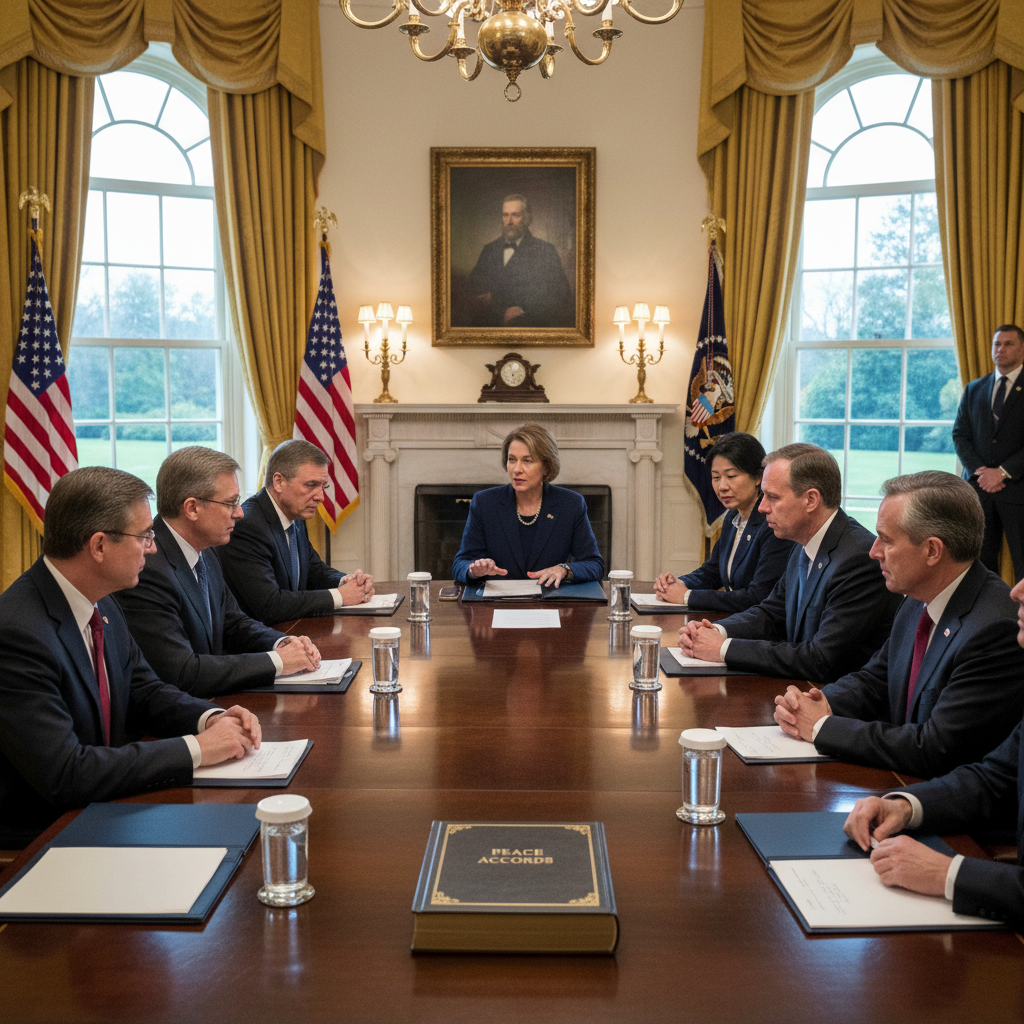
President Donald Trump again is taking on the mantle of a global dealmaker, announcing that he has already ended six wars by the start of his second term. He made the claim Monday in remarks to Ukrainian President Volodymyr Zelensky and several European leaders at the White House, where he also suggested he will resolve the destructive war in Ukraine.
“I’ve done six wars — I’ve ended six wars,” Trump said, adding that his interventions ranged from the Middle East to Africa to parts of Asia. “Look, India-Pakistan, we’re talking about big places. You just take a look at some of these wars. You go to Africa and take a look at them.”
The White House this month published an op-ed touting Trump as the “President of Peace” for accords or diplomatic initiatives related to Armenia and Azerbaijan, Cambodia and Thailand, Israel and Iran, Rwanda and the Democratic Republic of the Congo, Egypt and Ethiopia and Serbia and Kosovo. It also cited the Abraham Accords he signed in his first term to normalize ties between Israel and several Arab states.
For Trump, it’s not just the substance but also the image that matters. His critics see the achievements as exaggerated or short-lived, but his team is clearly promoting a track record that could bolster his long-standing pursuit of the Nobel Peace Prize.
Trump’s actual wins on some of these fronts are not permanent, foreign policy experts say. In some cases, the agreements amount to temporary ceasefires or lack the detail and enforcement needed for full peace treaties. The most striking example may be Israel and Iran. After a brief, high-intensity 12-day war, Trump was able to claim he had secured peace. In reality, the truce is informal, and tensions over Iran’s nuclear program have continued.
Trump has also had setbacks. His effort to broker an agreement between Israel and Hamas disintegrated as violence erupted again in Gaza, and his very public outreach to North Korean leader Kim Jong Un during his first term has not appeared to slow the growth of Pyongyang’s nuclear arsenal.
One of Trump’s more recent achievements was a declaration of peace between Armenia and Azerbaijan. Signed at the White House earlier this month, it requires the two countries to respect each other’s borders and to renounce violence. It also included a U.S.-facilitated transportation corridor that was dubbed the “Trump Route for Peace and Prosperity.”
Azerbaijani President Ilham Aliyev hailed the deal and the venue. “President Trump, in six months, did a miracle,” he declared. Analysts, however, warn that the two sides have not settled underlying constitutional and territorial questions, meaning the conflict is far from over.
Pressure Diplomacy in Southeast Asia and South Asia
In Southeast Asia, Trump threatened to suspend trade agreements with both Cambodia and Thailand unless they stopped a border clash that left at least 38 dead. That blunt use of leverage, together with efforts by the Association of Southeast Asian Nations (ASEAN), proved successful in ending the fighting. Cambodian Prime Minister Hun Manet nominated Trump for the Nobel Prize, describing it as “extraordinary statesmanship.”
Trump also stepped into a border flare-up between India and Pakistan in May, which has already seen three wars over the disputed Kashmir region. Pakistan publicly gave the U.S. credit, but India has denied the claims of U.S. mediation. The cease-fire is holding but fragile, with the underlying territorial issue left to fester.
Trump has also claimed credit for progress in Africa where Rwandan and Democratic Republic of the Congo leaders have signed an agreement to recognize each other’s borders and disarm militia groups. M23, the rebel movement at the center of the fighting, has rejected the accord, and some observers suggest it is part of a U.S. effort to counter Chinese influence over African mineral resources.
The president’s mention of Egypt and Ethiopia refers to their long-running dispute over a massive dam on the Nile River. Trump has called for both sides to compromise, but no binding agreement is in place.
The White House is also highlighting Trump’s role in promoting economic normalization between Serbia and Kosovo. Although the two countries have agreed to start direct talks, they remain diplomatically at odds, and much of the recent progress has been under the auspices of the European Union.
Trump’s emphasis on his ability to end wars also highlights his own unconventional diplomatic style and his willingness to exaggerate outcomes. Critics say he has undercut his own ability to turn ceasefires into lasting peace by decimating the State Department and U.S. Agency for International Development.
Even some skeptics of Trump’s record on ending wars note that his hands-on approach has sometimes paid off. “The ones that were helpful, especially India-Pakistan, were conducted in a professional way, quietly, diplomatically … laying the ground and finding common ground between the parties,” said Celeste Wallander, a former Pentagon official who is now at the Center for a New American Security.
The durability of Trump’s latest efforts, particularly on Ukraine, is not yet clear. The record so far is a mixture of bold interventions, branding of symbolism and unfinished business, leaving open the question of whether Trump’s legacy will be lasting peace or a string of ephemeral political victories.