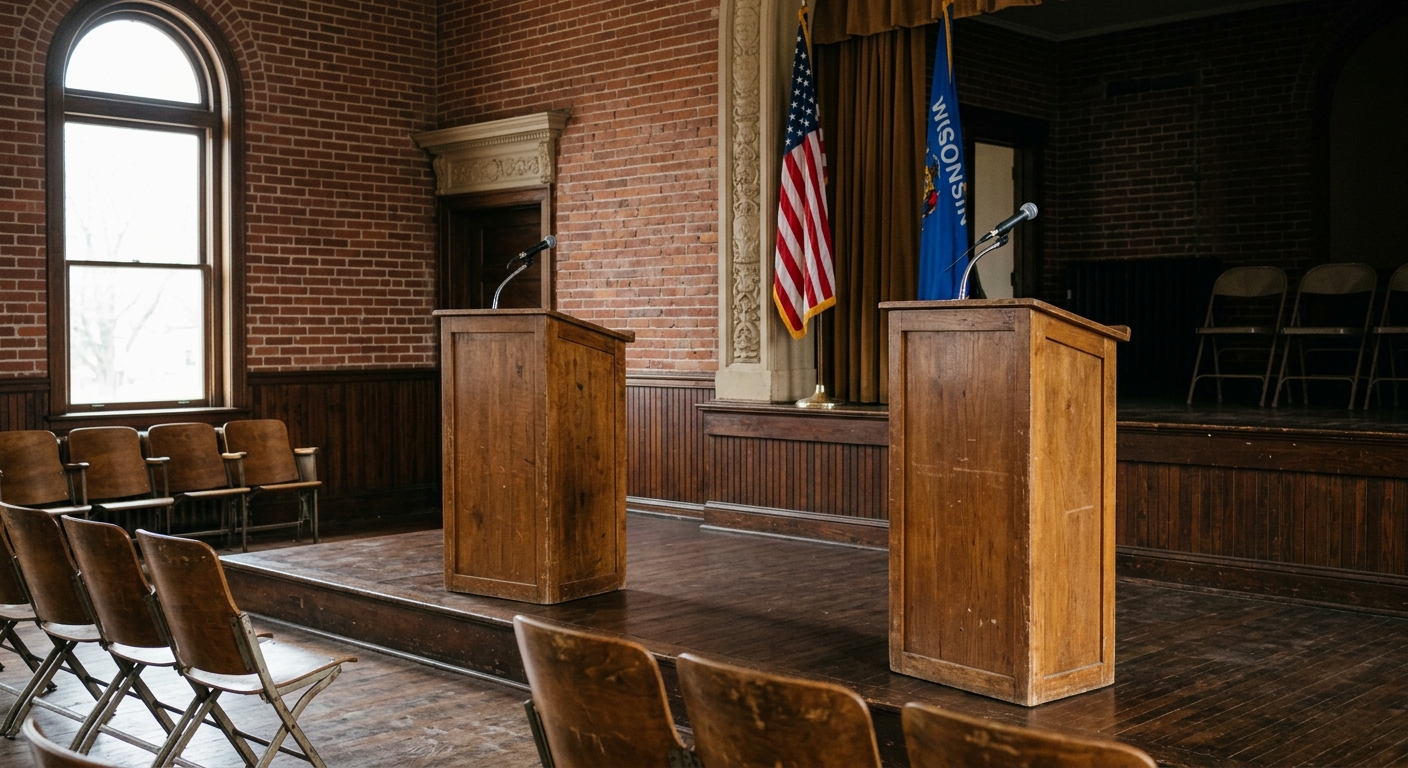
AI-generated illustration; not a photograph of the reported event.
- calendar_today October 9, 2026
El-Sayed and Rogers Face Off in Michigan Senate Debate
Democrat Abdul El-Sayed and Republican Mike Rogers went head-to-head in Grand Rapids for their first general election debate, tackling topics ranging from tariff policy and the Iran war to healthcare, candidate wealth, and data center investments. The hour-long session, moderated by Rick Albin of WOOD-TV, was marked by pointed exchanges and lasting disagreements between the candidates. They are set for a final debate in Detroit on October 21 before voters decide who will replace retiring Senator Gary Peters.
Tariff Policy and Charges of 'Political Flip-Flop'
Tariff policy emerged as a major issue, with El-Sayed accusing Rogers of flipping his stance—especially on tariffs with Canada. El-Sayed cited Rogers’ recent ad calling for an end to the tariff war, contrasting it with Rogers’s earlier support for the Trump administration’s tariff strategy, which last year Rogers called “masterful” and “necessary when countries cheat American workers.”
Rogers responded by sharing his support for a deal to end the tariffs and claimed to have discussed possible solutions with the Trump administration. Rogers also maintained that tariffs had helped Michigan’s manufacturing industry and "saved Traverse City cherries." However, while experts cited some benefits for the cherry industry, they also warned about rising costs due to tariffs. Reporters attributed improved cherry sales more to favorable weather and other factors than tariff policy itself.
Debate Over the Iran War
The Iran war was another contentious point. El-Sayed argued Rogers's current call for ending the war contradicted his previous long-standing support for the conflict. Notably, when the war began on February 28, Rogers described Iran as an imminent threat. In May, he called the war a "win-win-win," suggesting that peace would reduce U.S. military aid to Israel but acknowledged the heavy costs. During the debate, Rogers said the U.S. had achieved significant objectives in setting back Iran’s nuclear program and that it was time to "wrap it up." El-Sayed criticized this stance, questioning whether anyone was really winning.
Medical Credentials and Professional Records
Throughout the debate, Rogers questioned El-Sayed’s status as a "physician," asserting that El-Sayed does not hold a license to practice medicine and could not treat patients legally. El-Sayed does hold a medical degree from Columbia University but chose to pursue public health work instead of clinical practice. Michigan law reserves the "physician" title for board-licensed practitioners. El-Sayed dismissed accusations of inflating his credentials, referencing his Columbia degree and his public health career in Detroit and Wayne County.
Candidate Wealth and Real Estate Holdings
The candidates frequently challenged each other over their personal wealth and property. El-Sayed claimed Rogers earned $14 million after leaving Congress in 2014 and owns a multimillion-dollar property in Florida. According to public records, Rogers and his wife have a net worth between $7 million and $14 million and tried to sell their Florida home for $2.4 million after returning to Michigan. Rogers claimed El-Sayed is "worth a million bucks" and alleged foreign property holdings. Documents show El-Sayed and his wife are worth between $700,000 and $2.1 million, with rental properties in Dubai, UAE, and Bangalore, India, but not in Egypt.
Muslim Brotherhood Claims
Rogers repeated claims that El-Sayed's campaign is funded by groups supporting the Muslim Brotherhood. The reference appears to be to donations from staff at the Council on American-Islamic Relations (CAIR), a mainstream American civil rights group for Muslims. There is no corroborated evidence that CAIR supports the Muslim Brotherhood, and prior claims that El-Sayed pledged support to the Brotherhood have been found unsubstantiated. El-Sayed, in response, characterized the attacks as attempts to use his ethnicity and religion to distract from policy issues.
Healthcare, Prescription Drug Votes, and Data Center Investments
El-Sayed accused Rogers of being beholden to the pharmaceutical industry, citing four House votes against importing cheaper prescription drugs from Canada—a claim verified by voting records. Rogers defended his record, noting his support for expanding access to generic drugs to lower costs for Americans, a position often opposed by pharmaceutical companies.
Debate over data center investments also surfaced. Rogers claimed El-Sayed holds $100,000 in a mutual fund invested in companies related to data centers. El-Sayed replied that these mutual fund investments are part of his retirement portfolio and not directly controlled by him. Rogers himself has between $100,001 and $250,000 invested in Blackstone Real Estate Income Trust, involved in the Saline Township data center project near Ann Arbor, though the real estate is managed by a Related Companies Inc. subsidiary.
Source: bridgemi.com.