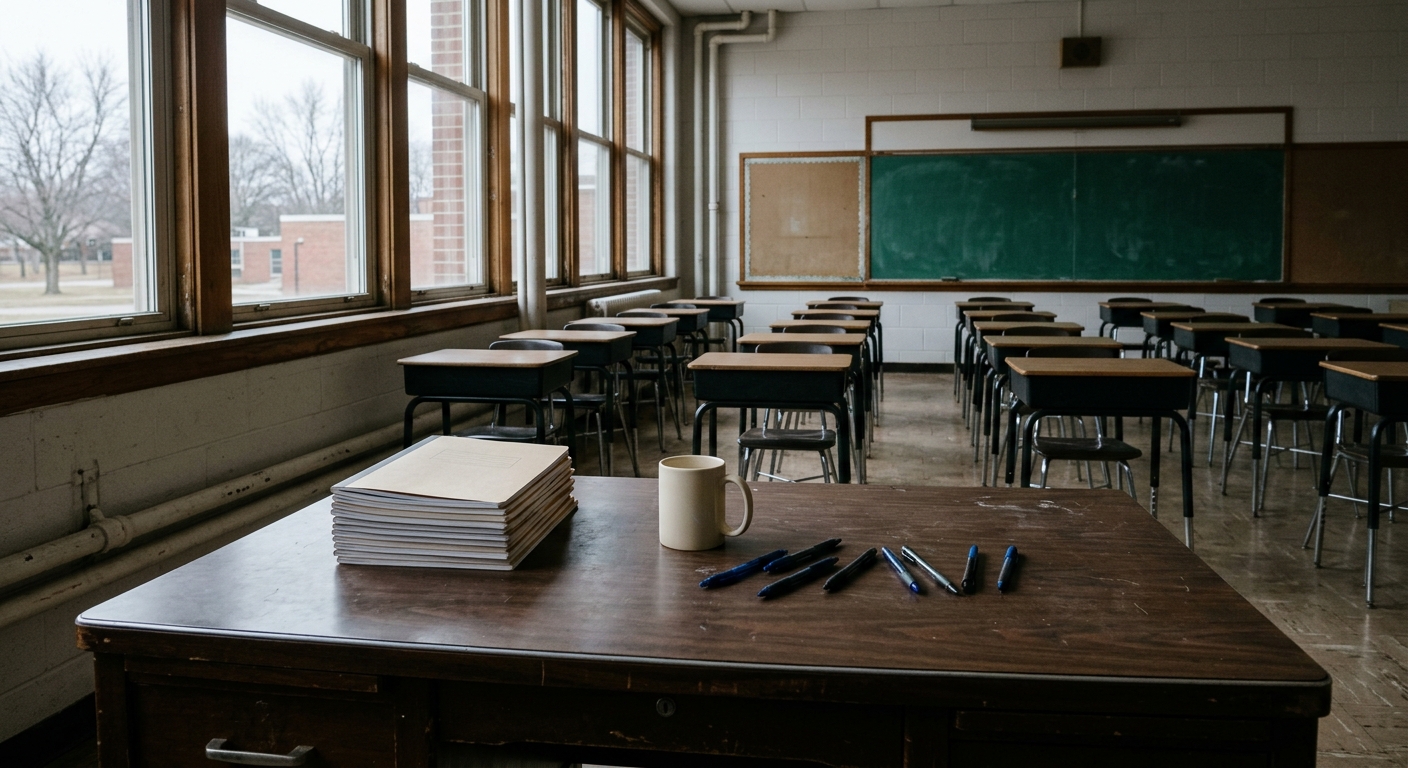
AI-generated illustration; not a photograph of the reported event.
- calendar_today November 13, 2026
Benson's Plan to Raise Michigan Teacher Pay
Gov.-elect Jocelyn Benson has announced a proposal to address Michigan’s teacher shortage by raising the starting teacher salary to a minimum of $60,000, a significant increase over the current average of just above $43,000. The move is a major education policy initiative for Benson, who campaigned partly on the promise of improving Michigan schools and boosting educator compensation.
Union Response: Broader School Employee Pay Increases Needed
The Michigan Education Association (MEA), the state’s largest teachers union, has expressed reservations about the plan’s focus on new teachers. Doug Pratt, MEA spokesperson, emphasized that the state faces staffing shortages not only among teachers but also with bus drivers and paraprofessionals. "It’s not just a question of starting salary," Pratt said, adding, "as a state we need to increase compensation for every school employee, not just teachers."
The MEA’s president, Chandra Madafferi, is part of Benson’s transition team, and the union has indicated willingness to work with the incoming administration and the Legislature to address these issues. However, financial specifics remain a concern.
Financial Implications and Public Opinion
Benson’s education agenda calls for scaling up compensation for experienced educators in addition to the $60,000 starting salary proposal. However, her team has not released specific cost estimates or identified potential funding sources. Jason Burns, a research specialist with the Education Policy Innovation Collaborative, previously estimated it would take $350 to $400 million to raise teacher pay in alignment with public opinion.
Recent polls suggest the public believes starting teacher salaries should be about $54,600, while average teacher pay should rise to $71,445. Another survey shows 72% of respondents support increasing starting teacher salaries statewide.
Benson’s office stated, "Governor-Elect Benson was proud to run on a bold vision of lowering costs, raising wages, and transforming state government. She looks forward to laying out her first 100 days agenda, including a bold education agenda, to deliver results for Michigan."
Michigan's Current Teacher Pay Structure
Currently, Michigan ranks 45th nationally in starting teacher pay, according to the National Education Association, with an average starting salary of $43,093. The state’s overall average teacher salary is $71,023, ranking 22nd nationwide. Traditionally, pay and other working conditions are negotiated locally between school districts and teachers unions, funded primarily through per-pupil state allocations.
Michael Van Beek, vice president for research at the Mackinac Center for Public Policy, noted that Benson’s proposal would represent a significant shift from local to state decision-making regarding teacher compensation.
Comparison to Other States and Policy Considerations
Other states have recently enacted minimum teacher salary laws. Tennessee, for instance, will increase its minimum teacher salary to $50,000 next school year, while Arkansas has raised its minimum from $36,000 to $50,000, granting all teachers at least a $2,000 raise. Research into Arkansas’s policy suggests the raises improved salaries and teacher retention in high-poverty, rural areas, though effects may lessen over time due to inflation.
Experts including Craig Thiel, research director at the Citizens Research Council of Michigan, caution that raising teacher salaries also requires districts to increase contributions to retirement systems and consider broader aspects of teacher compensation.
Additional Education Policy Initiatives
Benson’s broader education plan features the "Michigan Education Guarantee," aimed at ensuring all graduates are college or career ready through a comprehensive statewide graduation standard. This initiative is backed by Launch Michigan, a bipartisan nonprofit where MEA President Chandra Madafferi also serves as vice chair.
Stakeholders across the education sector agree that while raising teacher pay is important, addressing staff shortages and improving school quality will require comprehensive planning, sustainable funding, and attention to factors such as healthcare costs, retirement benefits, and working conditions.
Source: bridgemi.com.